Article
The Word “Law” in the Bible
The Scripture texts presented in Faith Point #20 show clearly that God’s commandments are just as binding upon Christians today as they were when God spoke them upon Mt. Sinai. In recent years, however, some people have developed the idea that Christians have no obligation to keep the Ten Commandments. We’d like to discuss those objections and demonstrate the unity of the Scriptures on the subject.
The first thing we need to understand is what the Bible writers meant when they spoke of “the law.” The primary Hebrew word translated “law” in the Old Testament is torah, which is so translated 216 times. In the New Testament, the word “law” is generally the Greek word nomos, which occurs 195 times.
Old Testament Usage
To the Hebrew mind, “law” was a broad term which stood for God’s revealed will. It encompassed all divine instruction, all God’s communication of His purpose for man. To the devout Jew, God’s “law” was equivalent to His plan for the salvation of man.
The context of an Old Testament passage using the word “law” may indicate that the writer is referring to a particular portion of God’s revealed will. God’s instructions given through Moses became known as “the Law of Moses.” Because the first five books of the Bible contained those instructions, that portion of Scripture was often called “the law of Moses” or simply “the law.” To the Hebrew mind, God’s instructions were His law, whether those instructions were moral standards, ritual requirements, or national policies. This general view of the law explains why the term can actually refer to a variety of things, the distinction between which was not necessarily considered significant.
New Testament Usage
By New Testament times, two distinct meanings of the term “law” had emerged, both of which reflected the thinking of the Jews in regard to the law as described above.
First, since the Scriptures were the place where God’s revealed will was preserved, the term “law” began to designate the Old Testament Scriptures, as a whole or in part (See John 12:34; 15:25; etc.). Often the term referred to the Pentateuch, or books of Moses, as distinguished from the Prophets and the Writings; and at times to the Decalogue (Ten Commandments) as a part of the Pentateuch.
Secondly, the expression also began to designate the Jewish religious system—whole or in part—which by that time had developed into an elaborate combination of Biblical instructions and rabbinical traditions (Acts 18:15, for example). For the Jews, this use of the term “law” was natural, for to them Judaism was the practical demonstration of God’s revealed will. New Testament references to works of the law often indicated the ceremonial element (Luke 2:22-24; Acts 15:5, 24), as that was the most apparent feature of the Jewish religious system.
When using texts referring to “the law,” it is wise to carefully study the setting of the passage to determine in what sense the word “law” is being used. It is also helpful to be familiar with the major elements of the Old Testament legal system, and understand the distinguishing qualities of each.
Three Types of Laws
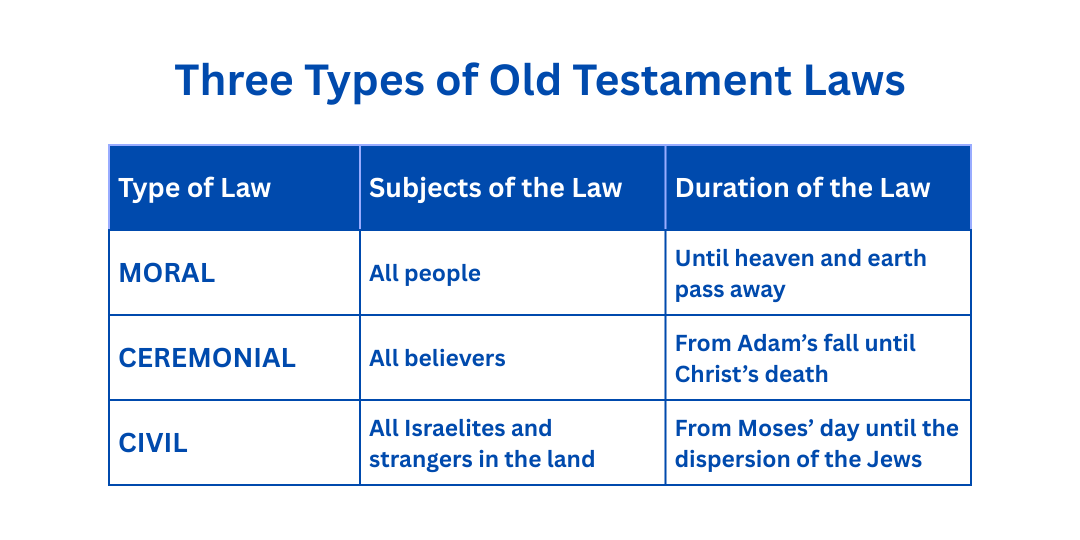
The Old Testament contains three basic types of laws—Moral, Ceremonial, and Civil. All three were given under God’s direction.
Moral Law
The Moral Law is the basis of God’s universal kingdom. It is the expression of God’s character. It exists because God exists, and as God is, so it is. The Moral Law combines a perfect blend of justice and mercy. It may be summed up in one word: Love.
All the requirements of God’s Moral Law hang upon two great principles. The first is Deuteronomy 6:5, “Thou shalt love the Lord thy God with all thine heart, and with all thy soul, and with all thy might.” The second is Leviticus 19:18, “Thou shalt love thy neighbour as thyself.”
God created men with His law “written in their hearts” (Romans 2:15). But because they “did not like to retain God in their knowledge” (Romans 1:28), the law was, for the most part, forgotten. It was therefore necessary for God to express His law in such a way that it would ever be remembered. With His own mouth He spoke the Ten Commandments, and with His own finger He wrote them on two tables of stone. The first four commandments, written on the first table, express one’s love for God. The last six commandments, written on the second table, express one’s love for his neighbor.
To carefully guard the sacredness of the Ten Commandments, God gave Moses additional precepts with minute instructions for everyday life. These “right judgments” and “good statutes” (Nehemiah 9:13) were simply applications of the principles of the Ten Commandments, and as such are classed as moral law.
The Moral Law defines righteousness, but has no power to redeem those who transgress it. A remedial system was therefore necessary whereby God “might be just, and the justifier of him which believeth” (Romans 3:26).
Ceremonial Law
Ceremonial laws were those that regulated the services of the sanctuary, the offering of sacrifices, and the priestly ministration. The Ceremonial Law is clearly distinguished from the Moral Law. Whereas the Moral Law defines the conduct of the righteous, the Ceremonial Law had to do with the plan of salvation and God’s work of grace for the repentant, believing sinner. It was through the Ceremonial Law that the righteousness of God was able to be “witnessed by the law and the prophets” (Romans 3:21).
Every ordinance of the Ceremonial Law pointed to Christ and His work of saving man from sin. Every animal that was slain typified Christ’s death on the cross. Every function the priests performed symbolized Christ’s ministry in the Heavenly Sanctuary. Every sacred festival foreshadowed a saving event in the redemption of the world.
God never gave the Ceremonial Law as a covenant of works whereby one could earn God’s favor through meritorious acts. There was no saving value in the sacrificial activities themselves. But through those activities the believer could by faith claim the righteousness of Christ to atone for his sins. It was “by faith” that Abel “offered unto God a more excellent sacrifice than Cain, by which he obtained witness that he was righteous” (Hebrews 11:4). And it was “through faith” that Moses “kept the passover, and the sprinkling of blood” (Hebrews 11:28). Thus the believer was continually to look forward to the “Lamb of God, which taketh away the sin of the world” (John 1:29).
Civil Law
Every country has civil regulations and the God-given authority for enforcing law and order. So to Israel as a nation were given laws governing the administration of justice. Specific instructions were given regarding the inflicting of penalties for the violation of the Moral Law (See Leviticus 24:16-20). These Civil Laws reflected mercy as well as justice (See Numbers 35:11-15). These laws, distinguished by their very nature, were of an inherently national type. Israel was subject to these laws in the same way in which we are subject to the laws of the land in which we live. “Submit yourselves to every ordinance of man for the Lord’s sake.” “Let every soul be subject unto the higher powers. For...the powers that be are ordained of God” (1 Peter 2:13; Romans 13:1).
Unlike the Ceremonial Laws, which were wholly symbolic in nature, the Civil Laws were not abolished by the death of Christ. Rather, they lost their force when Israel ceased to be a nation.