
Article
Lost Time?
Some people have wondered if the seventh day of the week is now the same day that it was when the Lord created the world. There is no question as to which day the Sabbath was in New Testament times, because the Creator Himself was on earth. His practice confirmed the Sabbath which the Jews had been observing all along as the true Lord’s Day. The part people have wondered about is during the centuries that have followed. How can we be sure that time has not been lost since then? We will look at five lines of evidence.
1. The Calendar
The calendar which was in use when Jesus was on earth was the “Julian Calendar,” named after Julius Caesar, who died 40 years before Christ was born. Its primary drawback was that it considered a year to be exactly 365 1/4 days long. Time revealed, however, that an actual solar year is eleven minutes and fourteen seconds shorter than that. After several centuries, the calendar would become out of step with the seasons.
It was discovered that it was necessary to add exceptions to the leap year plan which had been used in the Julian Calendar. Instead of having a leap year every fourth year, it was found necessary to omit the leap year whenever the fourth year landed on the beginning of a century, such as the year 1700, 1800, and 1900. The exception to that exception would occur whenever the century year was divisible by 400, such as the years 1600 and 2000.
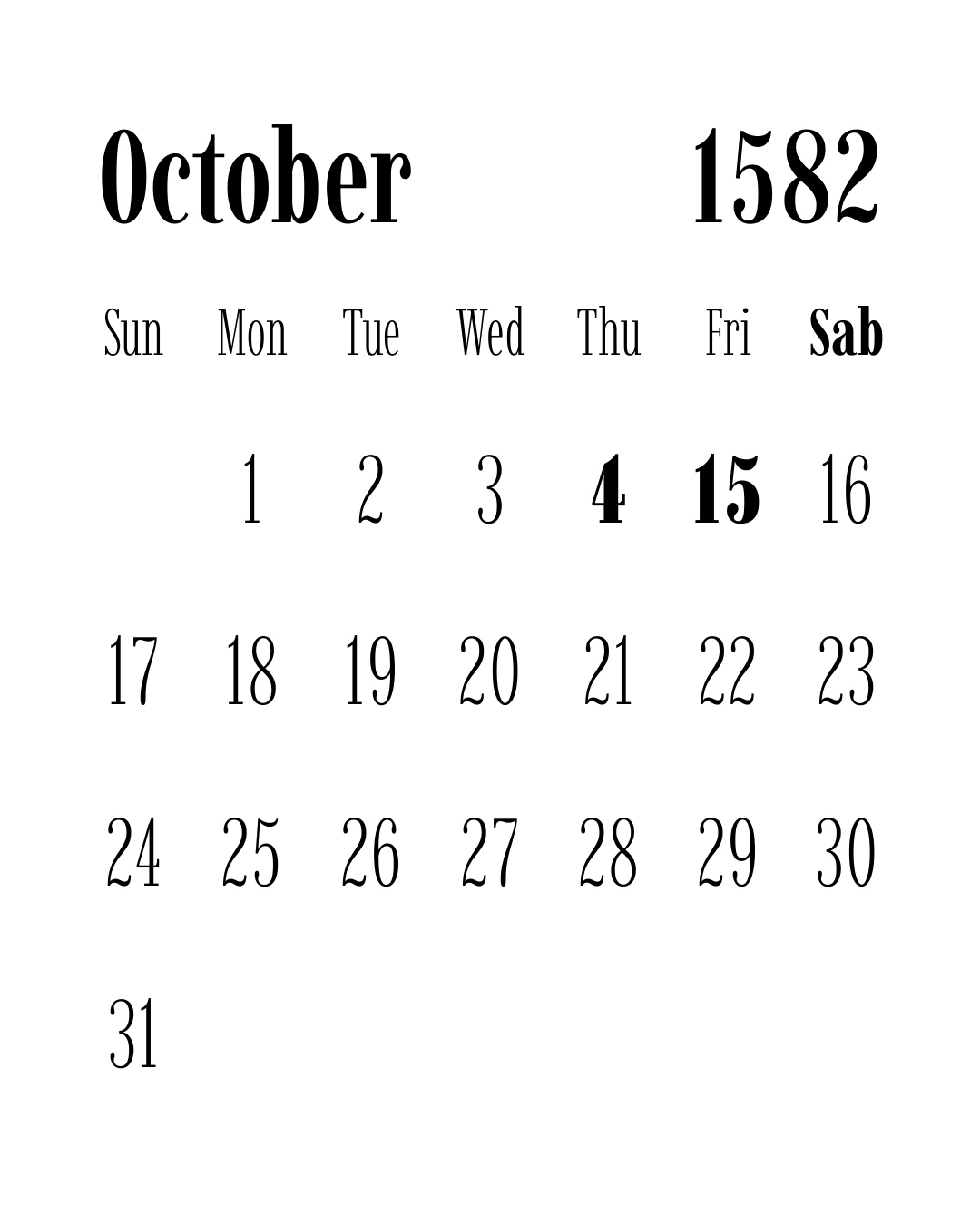
Between 1582 and 1923 each of the various nations of the world gradually adjusted its calendar to bring it back into step. The Catholic nations were the first to make the change. Pope Gregory XIII authorized a change in October of 1582 which dropped ten days from the calendar. By deleting October 5-14 from that year’s calendar, the dates were caught up where they should have been.
This change dealt only with the dates of that month, and had absolutely no effect upon the weekly cycle. The fifth day of the week, Thursday, October 4, 1582 was followed by the sixth day of the week, Friday, October 15, 1582. The weekly cycle was uninterrupted.
In other nations, the changeover was made later: English-speaking countries in 1752, Japan in 1873, China in 1912, Turkey and Russia in 1917, Serbia in 1919, and Greece in 1923. In each case the number of the date of the month was adjusted, but the days of the week were untouched. For example, in Britain and her colonies, the fourth day of the week, Wednesday, September 2, 1752, was followed by the fifth day of the week, Thursday, September 14, 1752.
Because not all countries adopted the change at the same time, the dates of the months varied from country to country for over 300 years. But one thing was the same through it all—the weekly cycle. They each had their own calendar; yet when it was Sabbath in Russia, it was Sabbath in Germany, England, Italy, and all over the world. The Encyclopedia Britannica calls it “the unalterable uniformity of the week.”
2. The Jewish People
The Jews have been careful to keep track of the true Sabbath. No change would slip past their notice.
3. Catholic Tradition
The Catholic Church dates back to the early centuries of the Christian era, and a change in the days of the week could not have inadvertently taken place without Catholics having something to say about it. But as their records show, they have guarded the identity of the first day of the week as faithfully as the Jews have the seventh.
4. The Languages of Man
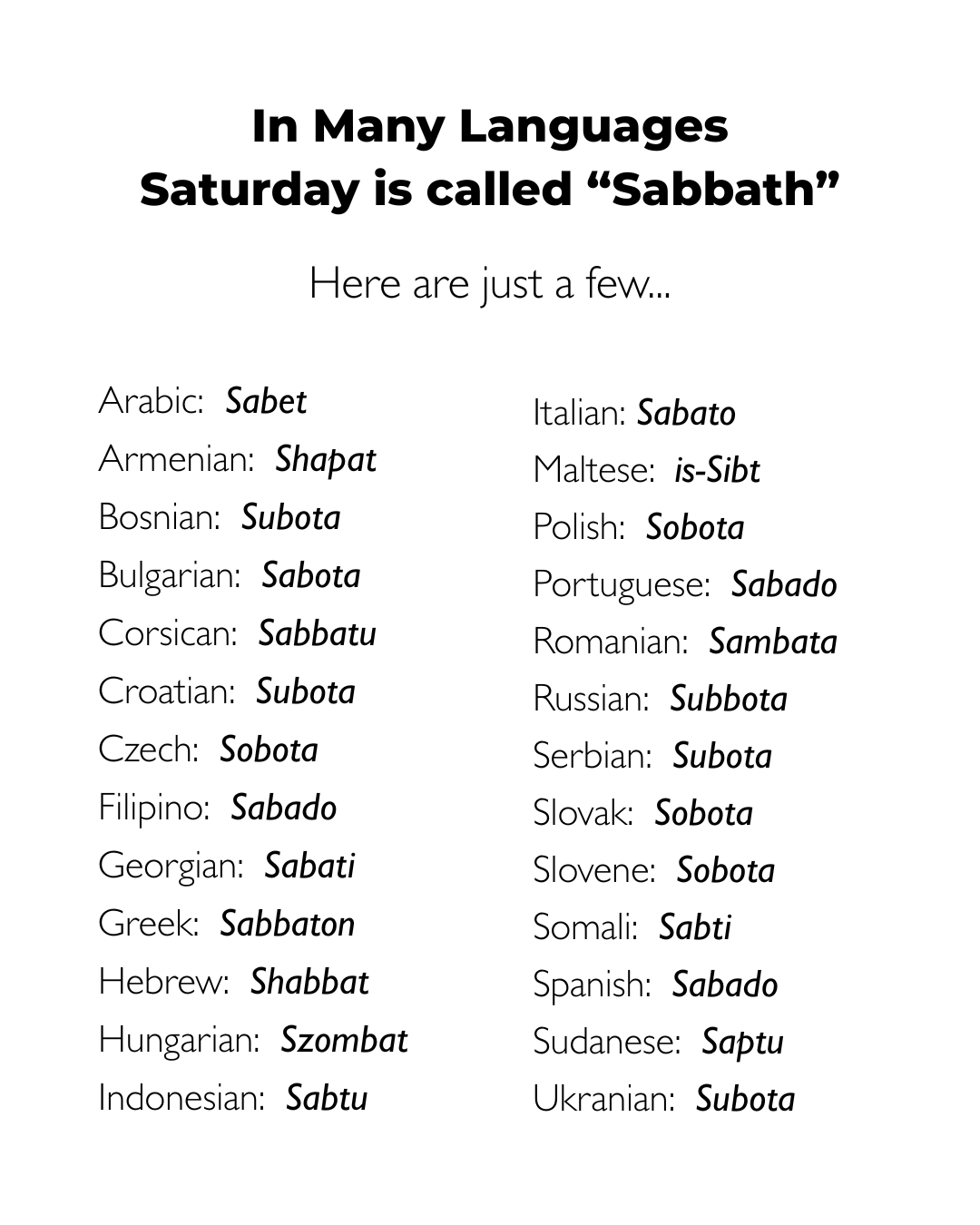
Here is a most fascinating evidence of a long-held and deeply embedded recognition of the seventh day throughout the world. In more than 100 languages, the actual common name for the day we call Saturday is “Sabbath.”
5. The Scientific Records of Astronomers
“We have had occasion to investigate the results of the works of specialists in chronology and we have never found one of them that has ever had the slightest doubt about the continuity of the weekly cycle.... There has been no change in our calendar in past centuries that has affected in any way the cycle of the week.” Dr. A. James Robertson, Director, American Ephemeris, Navy Department, U.S. Naval Observatory, Washington, D.C.
“As far as I know, in the various changes of the Calendar there has been no change in the seven day rota of the week, which has come down from very early times.” Sir Frank W. Dyson, Astronomer Royal, Royal Observatory, Greenwich, London.
“It is a strange fact that even today there is a great deal of confusion concerning the question of so-called ‘lost time.’ Alterations that have been made to the calendar in the past have left the impression that time has actually been lost. In point of fact, of course, these adjustments were made to bring the calendar into closer agreement with the natural year. Now, unfortunately, this supposed ‘lost time’ is still being used to throw doubt upon the unbroken cycle of the Seventh-day Sabbath that God inaugurated at the Creation. I am glad that I can add the witness of my scientific training to the irrevocable nature of the weekly cycle.
“Having been time computer at Greenwich for many years, I can testify . . . that all our days are in God’s absolute control—relentlessly measured by the daily rotation of the earth on its axis. This daily period of rotation does not vary one-thousandth part of a second in thousands of years . . . . Not a day has been lost since Creation, and all the calendar changes notwithstanding, there has been no break in the weekly cycle.” Dr. Frank Jeffries, Research Director of the Royal Observatory, Greenwich, England.
“The continuity of the week . . . is without a doubt the most ancient scientific institution bequeathed to us by antiquity.” Edouard Baillaud, Director of the Paris Observatory.
Even if all records of time should suddenly be lost, astronomers could rediscover the time simply by calculating the positions of the stars which God has set in place “for signs, and for seasons, and for days, and years.” Genesis 1:14.
Since God has asked us to keep the Sabbath day holy, He has also made sure there would be no confusion as to which day that is.